Burlington County, New Jersey · Mold guide
How Fast Does Mold Grow After Water Damage? The 24–48 Hour Rule
Dry wet materials within 24 to 48 hours to prevent mold growth. That is the EPA's guidance, and it makes the first two days after a leak or flood the most valuable time in the job. This guide walks the clock — hour by hour, material by material — to the point where a drying job becomes a separate remediation job, with its own scope and bill.
WaterPros Burlington County is a matching service by Signpost Local — not a contractor and not a remediation company. This guide summarizes EPA guidance and the restoration industry's standards; health questions about a specific exposure belong with a medical professional.
Mold spores are already inside every home — they drift in and settle everywhere. What they lack is moisture. A water event hands it to them, so the mold after water damage timeline is not contamination arriving — it is a switch being flipped. How quickly mold grows depends on warmth, material, and how long things stay wet — and Burlington County timing cuts both ways. A July basement flood in Mount Laurel fights South Jersey summer humidity the whole way — the air itself is wet, drying slows, and the window effectively shrinks. A January flood dries against heated, dry air. Same clock, different weather.
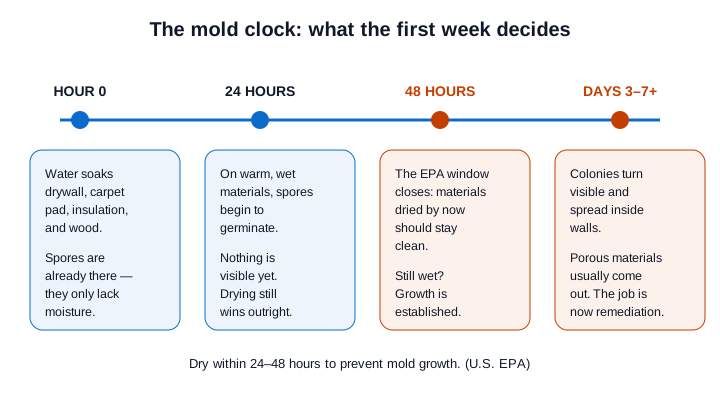
What happens hour by hour after water gets in?
| Window | What is happening | What it means for you |
|---|---|---|
| Hours 0–24 | Water migrates — drywall wicks it upward, carpet pad holds it, insulation and wood absorb it. Spores on wet surfaces begin germinating in warm conditions. Nothing is visible. | The cheapest hours of the entire loss. Extraction and real drying started now usually end the story here. |
| Hours 24–48 | Germination becomes early growth on the wettest materials. The EPA's prevention window is closing: materials dried by hour 48 should not grow mold. | Still winnable outright — but "the fans are running" has to mean moisture is actually leaving, not just air moving over a wet wall. |
| Days 3–7 | Visible colonies appear on materials that stayed wet — baseboards, drywall faces, carpet backing. Growth spreads inside wall cavities, where it is invisible and undisturbed. The musty smell starts. | Now there is something to remove, not just something to dry. Scope grows from drying to drying plus cleaning and selective removal. |
| Week 2 and beyond | Established colonies in porous materials; contamination spreads when disturbed. Drying alone no longer resolves it. | The job is remediation: containment, removal, HEPA cleaning. Different crew skills, different standard, different bill. |
Two qualifications belong on that table. The windows are guidance, not guarantees — a cold, clean-water wetting dried at hour 50 often ends fine, and a warm one can be a problem before hour 24. And visible growth is the late signal: by the time a colony shows on a wall face, the cavity behind it has usually been growing longer. The clock runs on the wettest hidden material, not the surface you can see. That is the 24 48 hour mold rule, whole.
Which materials grow mold first?
The order is set by food and porosity. Mold eats the organic material in building products, and it colonizes fastest where the food is exposed and the moisture lingers:
- Carpet pad and carpet backing — the sponge layer underfoot: holds water against the subfloor, dries slowest, rarely salvageable after a soaking.
- Drywall — the paper facing is food. The classic early casualty is mold on drywall wet through from a flood or wicking leak — established behind the paint while the face looks almost normal.
- Insulation in wall cavities — holds moisture against studs and drywall, invisible from the room — where mold in walls after flood events actually lives.
- Wood and particleboard — solid wood resists longer; engineered wood, subfloor, and cabinet bases swell, hold water, and feed growth early.
- Upholstery, cardboard, stored paper — basement contents on the floor are usually the first visible casualties — and the cheapest to have raised.
The pattern: porous and absorbent loses, hard and non-porous wins. Tile, concrete, metal, and glass clean and dry; absorbent materials that have grown mold — the EPA's examples are ceiling tile and carpet — may simply have to be thrown away, because growth fills the spaces inside them.
Pro Tip: Do not run an HVAC system whose ductwork got wet, or that pulls air through a wet area, "to help it dry." You risk distributing spores house-wide — we recommend leaving mold in the HVAC system to a professional, not a DIY job.
What are the signs mold already started?
The signs of mold growth, in the order homeowners notice them: first, the musty smell after water damage — an earthy odor that appears around day two or three and does not air out — it is being continuously produced. Second, visible spotting: dark or green-black flecks along baseboards, at the bottom edge of drywall, around carpet tack strips, on the underside of stored items. Third, surfaces that never quite dried — a wall still cool and damp days later, paint bubbling over a wet spot, flooring cupped or spongy. Fourth, allergy-type symptoms that flare in one room and settle elsewhere — a reason to look harder, not a diagnosis.
None of these needs a lab to interpret. The smell is a locating signal — growth exists somewhere, and the hunt is for the wet material feeding it.
When is mold remediation a separate job (and bill)?
Two different standards draw the line. Mitigation — the water job, governed by the IICRC S500 standard this site's categories and classes guide explains — is extraction and drying: stop the water, remove it, dry to the dry standard. Remediation — the mold job, under the IICRC S520 standard — is containment, removal of colonized materials, and HEPA cleaning. Mold remediation vs mitigation is not a pricing trick; it is the difference between drying and decontaminating a building.
The EPA gives homeowners a practical size line: if the moldy area is less than about 10 square feet — roughly a 3-by-3-foot patch — you can handle the cleanup yourself, with detergent, water, and complete drying. Past that line — or when growth is hidden in walls, in the HVAC system, or follows contaminated water — the EPA points you to a professional. Remediation pricing reflects the step up: mold removal averages about $2,369 in Angi's 2026 data — a separate line from the water job that preceded it, which is why the cheapest mold strategy remains the one in this site's first-24-hours guide and sump pump guide: prevent mold after leak and flood events by winning the drying window. Document as you go: mold coverage, where it exists, rides on the water claim under a sublimit (FAQ below).
Key Takeaways
| Question | The short answer |
|---|---|
| How fast does mold grow? | Germination can begin within 24 hours on warm, wet material; visible colonies in days. The EPA rule: dry within 24–48 hours to prevent mold growth. |
| What grows first? | Porous, food-rich materials: carpet pad, drywall paper, cavity insulation, particleboard — the hidden materials before the visible ones. |
| What's the first sign? | Usually the musty smell — active growth somewhere, often inside a wall — then spotting at baseboards and drywall edges. |
| When is it a separate job? | When growth is established: remediation (S520) is containment and removal, billed apart from mitigation/drying (S500). Angi puts average mold removal at about $2,369. |
| Can I handle it myself? | Per the EPA, small areas — under about 10 square feet — usually yes. Larger, hidden, HVAC, or contaminated-water growth is a professional job. |
A restorer's view: "dry to the touch" is not dry
The expert section of this guide is written from the restoration side of the business — the crews who dry these buildings and come back when the smell starts.
The sentence that precedes half the mold jobs I am called to is "but it felt dry." The face of drywall dries days before the cavity behind it; carpet feels dry while the pad underneath is still wet enough to grow a colony. Touch measures the millimeter you can reach, and mold lives in the ones you cannot. The only honest test is a moisture meter read against the dry standard — the same material in an unaffected part of the house. When a drying job closes, ask for the readings — start, dry standard, finish. If the answer is "it felt dry," your water damage mold risk did not end when the fans left. It just went quiet.
Water damage in the last two days — or a smell that just started?
Describe the problem once and get matched with an independent provider who serves your town. Inside the 48-hour window, speed is the whole job; past it, ask how they document moisture.
A matching service by Signpost Local — not a contractor. Call (833) 246-4240 to describe the problem once; the call button above dials the same number.
Frequently asked questions
Can mold grow in 24 hours?
It can begin to. On warm, wet material, spores can germinate within about 24 hours — invisibly. Visible colonies take days, and that gap is the trap: nothing to see at hour 24 does not mean nothing is happening. The EPA's guidance is built on this window — dry wet materials within 24 to 48 hours to prevent mold growth.
Does bleach fix mold?
Not the way most people mean it. The EPA's cleanup guidance is built on removal — scrub mold off hard surfaces with detergent and water, dry completely, and discard porous materials that have grown mold, because growth fills the spaces inside them where no spray reaches. Bleach can kill mold on a hard, non-porous surface, but it does not remove it — and dead mold may still cause allergic reactions, per the EPA. The goal is the mold gone, not the mold dead. On drywall or carpet pad, bleach treats the surface you can see and leaves the colony you can't.
Is the musty smell proof of mold?
It is a strong indicator, not proof of how much or where. A musty smell after water damage means something is growing somewhere — frequently out of sight, in a wall cavity or under flooring — because mold's odor comes from active growth. Treat the smell as a work order: find the moisture and the growth. A home that smells musty and looks clean is a common post-flood pattern; it resolves by finding the hidden colony, not by airing the room out.
Does insurance cover mold after water damage?
Sometimes — narrowly. Mold coverage usually exists only as a consequence of a covered water event (a burst pipe, for example), and many policies cap mold coverage at a low sublimit; check your declarations. Mold from slow leaks, humidity, or deferred maintenance is treated as a maintenance problem and excluded. The mold claim inherits the water claim's strengths and weaknesses — one reason the documentation habits in this site's insurance guide matter from hour one.
Should I test for mold?
Usually not to decide whether to act. If you can see growth, the remedy — remove it, dry the structure — is the same whatever a lab names it, and EPA guidance treats visible growth as the trigger for cleanup, not testing. Testing has real uses: clearance after a large remediation, a dispute about whether a job is done, symptoms with no visible source. But a spreading patch on wet drywall does not need a lab report to tell you what happens next.
Recommended Reads
- Water in Your Basement? The First 24 Hours in a Burlington County Home — the hour-by-hour checklist that wins the window this guide describes.
- Sump Pump Failed During a Storm? Why It Happens and How to Prevent a Flooded Basement — the failure that starts a large share of basement mold clocks, and the backup that prevents it.
- Water Damage Categories and Classes Explained (IICRC S500) — the classification system that sets the drying plan the clock runs against.
- How Long Does Water Damage Restoration Take? A Day-by-Day Timeline — the four phases, why drying typically takes 3–5 days, and how "done" is measured by readings, not dates.
- Water Damage in Burlington County, NJ — Local Pros, One Call — the matching page: describe the job once and get connected with a provider who serves your town.
- Which towns in Burlington County are covered? — the 29 towns and neighborhoods providers in the network serve.
This guide completes the site's ten-guide set. Every guide is linked from the home page and from each guide's Recommended Reads.
Sources
- U.S. EPA — Ten Things You Should Know About Mold: clean and dry damp or wet building materials and furnishings within 24–48 hours to prevent mold growth; moisture control is mold control.
- U.S. EPA — A Brief Guide to Mold, Moisture and Your Home: the under-about-10-square-feet rule of thumb for homeowner cleanup; dead mold may still cause allergic reactions, so mold must be removed, not only killed; porous materials that have grown mold may have to be discarded.
- U.S. EPA — What are the basic mold cleanup steps?: scrub mold off hard surfaces with detergent and water and dry completely; do not paint or caulk over moldy surfaces.
- Insurance Information Institute — Facts + Statistics: Homeowners and renters insurance: claims context for the coverage discussion; mold's sublimit and covered-peril framing is detailed in this site's insurance guide. Angi's 2026 cost data (mold removal averaging about $2,369) is cited in this site's cost guide.
- IICRC — S520 Standard for Professional Mold Remediation: the standard behind mold remediation (containment, removal, cleaning); the full standard is paywalled.
Ask an AI about mold after water damage
Open your assistant with this page already loaded as context.