Burlington County, New Jersey · Reference guide · IICRC S500
Water Damage Categories and Classes Explained (IICRC S500)
Every water loss is scored twice under the ANSI/IICRC S500 standard, the reference restoration companies and insurance adjusters share. The category rates how contaminated the water is, from 1 to 3. The class rates how much of the structure absorbed water and how hard it will be to dry, from 1 to 4. Those two numbers — written on the estimate as something like "Category 2, Class 3" — decide the safety rules, the scope of work, the drying time, and most of the price.
WaterPros Burlington County is a matching service by Signpost Local — not a contractor. This explainer exists so that when a provider classifies your job, you can read the classification instead of just trusting it.
Homeowners usually meet these ratings on the worst day of the year, printed on an estimate they have no way to check. That is backwards. Category and class are not sales labels — they are defined terms in a published standard, assigned from the water's source and from moisture-meter readings, and an adjuster will later audit the job against exactly these definitions. This page is the IICRC S500 explained in plain terms: what each rating measures, the household examples that earn it, and how the two ratings together turn into the scope and the bill. If you want the prices that follow from the ratings, they are in this site's Burlington County cost guide; this page is about the ratings themselves.
What are the three categories of water damage?
Category answers one question: how contaminated is this water? The rating is set by the water's source and by what it has contacted, and it drives the safety side of the job — protective equipment, containment, and which materials may be dried in place and which must come out. (Together, category 1 2 3 water damage and class 1 through 4 are the full S500 scoring system this page explains.)
| Category | What it means | Typical household sources |
|---|---|---|
| Category 1 — clean water damage | Water from a sanitary source that poses no substantial health risk at the time it is released | Broken supply lines, burst pipes, melting snow or ice, a sink or tub that overflows without contaminants |
| Category 2 — gray water | Water with significant contamination that can cause discomfort or illness if contacted or consumed | Washing machine and dishwasher overflows, toilet overflows containing urine only, water that has passed through building materials |
| Category 3 — black water damage | Grossly contaminated water, by definition | Sewage backups, river and storm flooding, seawater, water that has stood long enough to support microbial growth |
Two properties of category surprise people. First, category is about the water, not the room — the same basement can host a Category 1 loss from a burst pipe in January and a Category 3 loss from Rancocas Creek water in July. Second, category degrades. Clean water does not stay clean: as it sits it picks up contaminants from building materials and supports microbial growth, and the rating moves up. That is the technical version of the rule in our first-24-hours guide — the EPA's window for drying water-damaged areas and items is 24 to 48 hours, and a loss classified on day one may be reclassified higher on day three. Gray water cleanup delayed becomes, in part, black water work — at black water prices and black water safety rules.
Pro Tip: When a provider tells you a category, ask what source earned it. The answer should name the water and what it touched ("dishwasher overflow that sat overnight"), not just the number. A category without a source is an opinion; a category with one is the standard applied.
What are the four classes of water loss?
Class answers the other question: how much water is in the structure, and how hard will it be to get out? For Classes 1 through 3 the rating is set by the percentage of a room's combined floor, wall, and ceiling surface area that absorbed water. Class 4 breaks the pattern — it is defined by material, not area.
| Class | Wet surface area (floor + wall + ceiling) | What it usually looks like | Drying difficulty |
|---|---|---|---|
| Class 1 | Under 5% | A slow supply-line leak caught early; a small section of flooring or drywall; little wicking | Easiest — dries fastest, least equipment |
| Class 2 | 5% to 40% | A whole room's carpet and pad saturated; water wicked up walls to roughly 24 inches | Moderate |
| Class 3 | Over 40% | Water from overhead — an upstairs overflow or ceiling burst — soaking ceilings, walls, insulation, and floors | Highest evaporation load of the area-based classes |
| Class 4 | Not area-based | Water bound deep in hardwood, plaster, concrete, brick, or stone, regardless of the area involved | Hardest — specialty drying situations |
Class 4 deserves its own paragraph because it breaks homeowners' intuition that a small area means a small job. A refrigerator line that leaks undetected for days into hardwood flooring can be a modest area and still a Class 4 loss, because hardwood, plaster, and concrete are low-permeance materials: they take water deep and release it slowly. Standard air movers and dehumidifiers are not enough on their own; Class 4 work can call for injection drying, desiccant dehumidification, or heat. In Burlington County's older housing stock — the plaster walls and hardwood floors of Mount Holly, Burlington City, and Riverside homes — Class 4 is not an edge case; it is the normal complication.
One more mechanic matters: class is finalized after demolition, not at the first walkthrough. Removing soaked carpet pad and waterlogged drywall changes how much wet surface remains, so the class on the final documentation can differ from the first estimate — in either direction, and legitimately. A class of water loss can also rise mid-job when a crew opens a wall and finds saturation the meters could only hint at.
How do category and class change the restoration plan?
The two ratings are independent — any category can pair with any class — and each one controls a different half of the plan:
- Category sets the safety and salvage rules. It decides the protective equipment a crew wears, whether containment goes up, and what gets dried in place versus bagged and removed. Porous materials touched by Category 3 water — carpet, pad, insulation, drywall, upholstery — are typically discarded, not dried. This is the sewage water category rule homeowners find hardest to accept, and it is not negotiable inside the standard.
- Class sets the drying plan. Class is the main input for how many air movers and dehumidifiers a room needs, because the equipment count follows the evaporation load — how much water has to move out of the materials. A Class 1 corner may dry with one air mover and a small dehumidifier; a Class 3 room needs several, plus daily monitoring against a dry standard.
- Together they set the price. Angi's 2026 averages price the category side directly — clean water $3.50, gray water $5.25, black water $7.50 per square foot — while class drives the equipment days and demolition that sit on top of the rate. That is why two rooms of identical size can carry honestly different quotes, a point the cost guide works through in dollars.
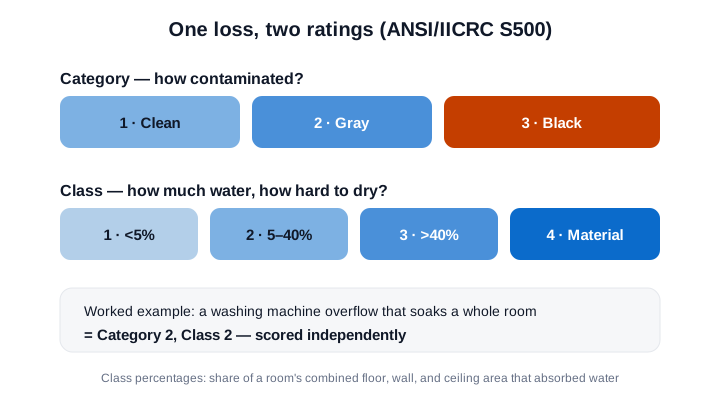
The worked example makes the independence concrete. A washing machine overflow that soaks an entire laundry room and hallway is Category 2 — gray water from an appliance — and, with a whole room's carpet saturated and water wicked up the walls, likely Class 2 as well. Move the same appliance failure upstairs, let it saturate the ceiling and walls of the room below, and the category stays 2 while the class climbs to 3. Same water, same machine, different job — because the two numbers were never measuring the same thing. Water contamination levels and drying class are separate axes, and an estimate that gives you only one of them is half a diagnosis.
Pro Tip: A burst pipe that floods a finished basement with clean water is Category 1 and can still be Class 3 — over 40% of the room's surfaces wet. Do not let a "clean water" label talk you into a small-job expectation; ask for both numbers before you judge any quote.
Why do these ratings decide what your insurer pays?
Because category and class are the shared language the claim is written in. The standard a Burlington County restoration pro scopes by — ANSI/IICRC S500 — is the same reference the adjuster audits by. A job file built on the standard's documentation is hard to argue with: the assigned category and class, moisture-meter readings taken against a dry standard from an unaffected part of the house, thermal imaging where hidden saturation is suspected, and a daily drying log showing readings trending to target. Drying is done, under the standard, when the readings meet the dry standard — not when a calendar says enough days have passed.
The ratings also frame the two arguments insurers and homeowners actually have. The first is classification: was this loss really Category 3, with its demolition and disposal scope, or Category 2 that a crew could dry in place? The second is timing: category degrades, so a claim filed on a loss that sat wet for a week can meet the position that the higher scope was avoidable. Both arguments are settled by the same evidence — early photos, a prompt call, and readings in the file. That is why the first-24-hours discipline matters financially, not just biologically: the classification you can prove is the classification that gets paid. Water loss classification, done to the standard and documented, is what turns a restoration invoice into a covered claim.
Key Takeaways
| Question | The short answer |
|---|---|
| What does category measure? | Contamination, 1 to 3: clean water, gray water, black water (IICRC S500). |
| What does class measure? | How much surface absorbed water and how hard it is to dry, 1 to 4 — under 5%, 5–40%, over 40% of combined floor, wall, and ceiling area; Class 4 is material-based. |
| Are the two ratings connected? | No — they are independent. One loss carries both, e.g. Category 2, Class 3. |
| What does each rating control? | Category: safety, containment, what gets discarded. Class: equipment count, drying time, specialty methods. |
| Why does the insurer care? | Pros and adjusters share the S500 standard — the ratings plus moisture readings and the drying log are the claim's evidence. |
An estimator's view: how to read a restoration estimate
The expert section of this guide is written from the estimating side of the business — the person whose classification decisions set both the scope and the claim.
When I hand a homeowner an estimate, the two lines I want them to find are not the totals. They are the category and class line, and the moisture readings underneath it. Those lines tell you whether the number at the bottom was derived or invented. A derived estimate can show its work: this category, because the water came from this source; this class, because these surfaces, in this room, read at these moisture levels against a dry standard measured in an unaffected room; this many equipment days, because that class carries that evaporation load. An invented estimate is a round number with a company logo. If two quotes for your job differ wildly, compare the classification lines before you compare the prices — nine times out of ten, the cheaper quote has quietly assumed a lower category, a lower class, or a drying plan with no readings in it. You are not obliged to accept my classification. You are entitled to see it.
Got an estimate you cannot read?
Describe the problem once and get matched with an independent water damage provider who serves your Burlington County town. Ask the matched pro for the category, the class, and the readings behind both — then compare scopes, not just totals.
A matching service by Signpost Local — not a contractor. Call (833) 246-4240 to describe the problem once; the call button above dials the same number.
Frequently asked questions
Is Category 3 water dangerous?
Yes. Category 3 water is grossly contaminated by definition under the IICRC S500 standard — it includes sewage and floodwater. Crews work in protective equipment with containment, and porous materials it touches, such as carpet, insulation, and drywall, are usually removed and disposed of rather than dried.
Can clean water become black water?
Yes. A Category 1 loss can degrade to Category 2 or 3 over time as the water contacts building materials and supports microbial growth. That degradation is one reason the EPA's 24 to 48 hour drying window matters — the classification you start with is not the one you keep if the water sits.
Who decides the category and class of a water loss?
The inspecting restoration professional assigns both ratings following the ANSI/IICRC S500 standard, based on the water's source and on moisture-meter readings taken in the home. Class is finalized after unsalvageable materials are removed, because demolition changes how much wet surface area remains.
Does the class of a loss affect drying time?
Yes. Class is the main input for how much drying equipment a room needs: Class 1 losses dry fastest, while Class 3 carries the highest evaporation load of the area-based classes and Class 4 — water bound deep in hardwood, plaster, or concrete — can take the longest and needs specialty drying methods.
Is floodwater always Category 3?
Yes. Under the IICRC S500 standard, water that enters from outside — river flooding, storm water, and seawater — is Category 3 by definition, no matter how clear it looks, because of what it may have contacted on the way in.
Recommended Reads
- Does Homeowners Insurance Cover Water Damage? What NJ Homeowners Get Wrong — the sudden-and-accidental rule, the exclusions that surprise people, and how to document a claim so it survives the adjuster.
- Which Burlington County Towns Flood — and Why the Delaware River Is Only Half the Story — the county's two flood systems, the towns each one reaches, and how to check your own parcel.
- How Much Does Water Damage Restoration Cost in Burlington County, NJ? — what the ratings do to the bill: per-square-foot rates by category, and how class drives equipment and demolition costs.
- Water in Your Basement? The First 24 Hours in a Burlington County Home — the emergency checklist for keeping a loss at the lowest category and class it can be.
- How Fast Does Mold Grow After Water Damage? The 24–48 Hour Rule — the EPA clock, the materials that colonize first, and when cleanup becomes a separate remediation job.
- How Long Does Water Damage Restoration Take? A Day-by-Day Timeline — the four phases, why drying typically takes 3–5 days, and how "done" is measured by readings, not dates.
- Sewage Backup in Your Home: Why It's a Biohazard Job, Not a Cleaning Job — Category 3 rules: what to do first, what gets thrown away, and the endorsement trap.
- Water Damage in Burlington County, NJ — Local Pros, One Call — the matching page: describe the job once and get connected with a provider who serves your town.
- Which towns in Burlington County are covered? — the 29 towns and neighborhoods providers in the network serve.
This guide completes the site's ten-guide set. Every guide is linked from the home page and from each guide's Recommended Reads.
Sources
- RestoreAdvisor — Water Damage Classes 1–4 Explained (IICRC S500): the class thresholds (under 5%, 5–40%, over 40% of combined surface area), Class 4 as a material-based specialty drying situation, class finalized after demolition, and class versus category as independent systems.
- RestoreAdvisor — Mold After Water Damage: Timeline, Risks & What to Do: category definitions and sources, category degradation timelines, and material salvageability by category.
- Angi — How Much Does Water Damage Restoration Cost? (2026 data): per-category pricing — clean water $3.50, gray water $5.25, black water $7.50 per square foot.
- U.S. EPA — A Brief Guide to Mold, Moisture and Your Home: dry water-damaged areas and items within 24–48 hours to prevent mold growth.
- IICRC — ANSI/IICRC S500 Standard for Professional Water Damage Restoration: the standard is paywalled, so this page is a summary of it and the category and class definitions here follow summaries of the standard (current edition: fifth, 2021) rather than text on the IICRC web page; it is the reference both restoration professionals and adjusters work from.
- IICRC — S520 Standard for Professional Mold Remediation: the companion standard for mold remediation; the full standard is paywalled.
Ask an AI about water damage categories and classes
Open your assistant with this page already loaded as context.