Burlington County, New Jersey · Emergency guide
Water in Your Basement? The First 24 Hours in a Burlington County Home
The first 24 hours after water gets into a basement decide whether you have a drying job or a mold-and-demolition job. The U.S. EPA's rule is the reason: dry water-damaged areas and items within 24 to 48 hours, and you prevent mold growth. Everything in this checklist is ordered to protect that window — safety first, then the calls, then the proof your insurer will ask for.
WaterPros Burlington County is a matching service by Signpost Local — not a contractor. If you need wet basement help right now, describe the problem once and get matched with a provider who serves your town; read this while you wait.
For a flooded basement what to do first is simple: work this page top to bottom. This first 24 hours water damage guide is written for the two ways Burlington County basements usually fill: a plumbing or sump failure inside the house, and storm water from outside — the kind that hit the Delaware River corridor in western Burlington County during the July 12, 2021 flash flood, when National Weather Service-reviewed rainfall ran from about 3.5 to 7.6 inches and rescues were made in Florence, Edgewater Park, Palmyra and Riverside. A failed sump pump is a common basement cause during storms, and it changes what you tell the person you call. Either way, the order below is the same, because the clock is the same. Consider this your basement flood cleanup checklist.
What should you do in the first hour?
The first hour has one job: stop the damage from growing while help gets moving. These water in basement first steps, in order:
- Stop the water, if you safely can. Close the main shutoff for a burst pipe or failed appliance line. If the sump pump failed, say exactly that when you call — a pump failure is a different scope than a plumbing leak, and it may need its own insurance endorsement to be covered.
- Make it electrically safe. If water is near outlets, appliances, or the panel, shut off power to the affected area at the breaker — only if you can reach the panel without standing in water. If you cannot, stay out of the water and tell the pro; that fact changes how they enter.
- Call a restoration pro before you clean anything. Emergency water removal is a 24/7 service, and the drying window does not pause while you mop. During county-wide storms, Burlington County wait times spike — the July 2021 event had crews committed for days — so the call goes first and the documenting happens while you wait.
- Get people and pets out of the water, and keep kids out of the basement until you know what kind of water it is (see the next section).
- Carry up what water ruins fastest — documents, photos, electronics, and anything cardboard-boxed on the floor — but only what you can move without wading through water you were told to stay out of.
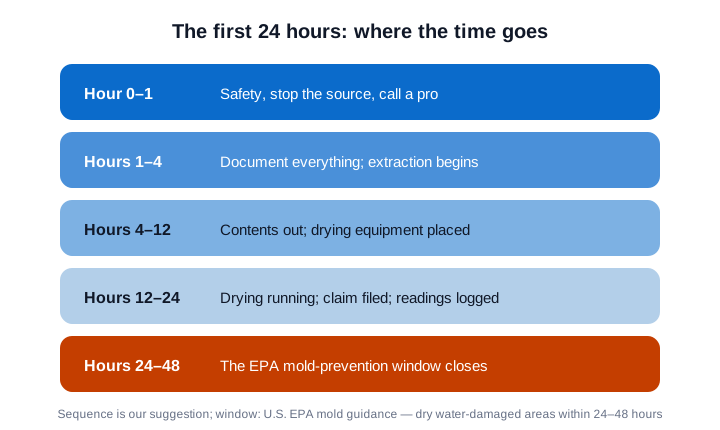
Our suggested sequence, not a sourced standard; only the 24 to 48 hour drying window comes from the EPA.
| When | What happens | Whose job |
|---|---|---|
| Hour 0–1 | Source stopped, power made safe, pro called | You |
| Hours 1–4 | Photos and video of everything; extraction begins | You, then the pro |
| Hours 4–12 | Standing water out, contents moved, drying equipment placed from moisture readings | The pro |
| Hours 12–24 | Drying running continuously; insurance claim filed; first drying log recorded | The pro, and you |
| Hours 24–48 | The EPA's mold-prevention window closes — materials still wet now carry mold risk | The clock |
Pro Tip: Treat the call as step one of cleanup, not a break from it. Every hour spent extracting and drying inside the first day is worth more than the same hour on day three — that is how you stop water damage spreading from a wet floor into walls, insulation, and a mold line item.
What should you never do with standing water?
Standing water in house or basement punishes four mistakes, and all four are tempting at 2 a.m.:
- Never wade into water you cannot clear electrically. If water may have reached outlets, a water heater, or the panel and you could not shut the power off dry, the basement is closed until a pro or an electrician says otherwise.
- Never treat sewage or outside floodwater as a cleaning job. Under the IICRC S500 standard that water is Category 3 — grossly contaminated by definition. It is a do-not-enter without protective equipment, porous materials it touches are typically removed rather than dried, and it is priced at the top of the cost scale for exactly those reasons (see the Burlington County cost guide).
- Never run the HVAC if water reached the ductwork, air handler, or drain pan. The system that dries your air in July will distribute basement moisture and contaminants to every room it serves.
- Never wait for a better hour. FEMA's outreach materials illustrate that even one inch of water can cause roughly $25,000 in damage, and the mold window runs overnight and on weekends. A basement water emergency at 2 a.m. is priced and handled like one at 2 p.m. — if you call.
How do you document damage for insurance before cleanup?
Document before anything is moved, pumped, or thrown away — this is the step that decides whether the bill becomes a claim. Work room by room with your phone:
- Video first, walking slowly, narrating the time and where the water came from. Then wide photos of every wall, and close-ups of the water line on walls, furniture, and appliances.
- Photograph serial plates on the water heater, washer, furnace, and anything else the water reached. These flooded basement insurance photos are what an adjuster matches against your claim list, item by item.
- Write the timeline while it is fresh: when you found it, what you think failed, when you called for help. Insurers decide water claims on the line between sudden and gradual damage, and a same-day record is evidence you were on the right side of it.
- Keep the damaged materials your pro removes until the adjuster releases them, and keep every receipt — supplies, a rented pump, a hotel night. Documentation is also why an exact restoration price only exists after an inspection, as the cost guide for this site explains.
When does it stop being a DIY job?
A shop vac and a dry afternoon handle a small, clean-water spill you caught the same hour. Water in the basement stops being a DIY job when any of these are true:
- The water is sewage, or it came from outside the house — Category 3, a professional scope by definition.
- Water touched the electrical panel, ductwork, or HVAC equipment.
- Water stands across a finished basement, or soaked into drywall and insulation — household fans cannot dry wall cavities to the moisture standard pros measure against.
- You cannot plausibly have it dry within 24 to 48 hours. Missing the EPA window converts a drying job into drying plus mold removal, which Angi averages at $2,369 on its own line.
- The cause is a failed sump pump during a storm and more rain is coming — the basement will refill faster than one person can empty it.
One Burlington County special case: Pinelands-edge homes on well and septic — in Chatsworth, New Lisbon, Pemberton, and similar communities — should ask the responding pro directly whether the well pump should be shut off if flooding reaches it, and whether the septic system needs to stay unused until the water drops. That is a question for the pro on site, not a step to improvise.
Pro Tip: Count the list above honestly. If two or more apply, every DIY hour you spend is a drying hour lost — the most expensive trade in the first 24 hours.
Key Takeaways
| Question | The short answer |
|---|---|
| What is the deadline that matters? | Dry water-damaged areas and items within 24 to 48 hours to prevent mold growth (EPA). |
| What is the first move? | Stop the source if it is safe, make the power safe, then call a pro — before cleaning anything. |
| What water is never DIY? | Category 3 — sewage and outside floodwater (IICRC S500): do not enter without protective equipment. |
| What protects the insurance claim? | Photos and video of everything before cleanup, a written timeline, and keeping damaged materials for the adjuster. |
| How much can an inch of water cost? | FEMA's outreach materials illustrate roughly $25,000 in damage from one inch of water — shallow water is not minor water. |
A restoration tech's view: the triage order, and why it is in that order
The expert section of this guide is written from the responding tech's side of the job — the order below is the order a first visit actually runs in.
When I walk into a flooded basement, I work the same order every time: source, safety, extraction, documentation. Source first, because pumping against a live leak is billing you to lose. Safety second, because water and electricity decide who is allowed in the room, and contaminated water decides what we wear into it. Extraction third, because standing water is the damage still happening — every material it touches is moving up a category while it sits. Documentation runs through all of it: I shoot photos as I go, and my first moisture readings become your claim file. Homeowners sometimes apologize for not having cleaned before we arrive. Do not clean before we arrive. An untouched basement with the water line still on the wall is the easiest claim I can hand an adjuster — and the fastest basement to dry.
In the first 24 hours? Start the clock now
Describe the problem once and get matched with an independent water damage provider who serves your Burlington County town — from Beverly to Wrightstown, all 29 covered towns. The provider confirms timing and price with you directly, and emergency calls are taken around the clock.
A matching service by Signpost Local — not a contractor. Call (833) 246-4240 to describe the problem once; the call button above dials the same number.
Frequently asked questions
Should I call my insurance company or a restoration pro first?
Call the restoration pro first. Extraction and drying run on a 24 to 48 hour clock that a claims queue does not stop for, and emergency water removal is a 24/7 service. Then notify your insurer the same day — your photos and the pro's moisture readings become the core of the claim file.
Is it safe to run my HVAC while there is water in the basement?
Not if water reached the ductwork, the air handler, or the drain pan. Running the system can spread moisture and contaminants from the basement through the whole house. Leave it off and let the restoration pro who inspects the job tell you when it is safe to run again.
Can I sleep in the house after my basement floods?
It depends on the category of water. A limited clean-water loss confined to the basement usually leaves the upstairs fine for sleeping. Sewage or floodwater from outside is Category 3, the most contaminated class — stay out of the affected area and plan to stay elsewhere until a pro has assessed it.
How fast can mold start growing after a basement flood?
The EPA's guidance is to dry water-damaged areas and items within 24 to 48 hours to prevent mold growth. Materials still wet after that window carry mold risk, which is why the first day matters.
What if my basement floods at 2 a.m.?
Call anyway. Emergency water extraction runs around the clock because the drying clock matters more than the hour — waiting until morning can spend up to half of your 24-hour starting window and a large share of the 24 to 48 hour mold-prevention window before anyone has started work.
Recommended Reads
- Does Homeowners Insurance Cover Water Damage? What NJ Homeowners Get Wrong — the sudden-and-accidental rule, the exclusions that surprise people, and how to document a claim so it survives the adjuster.
- Which Burlington County Towns Flood — and Why the Delaware River Is Only Half the Story — the county's two flood systems, the towns each one reaches, and how to check your own parcel.
- Water Damage Categories and Classes Explained (IICRC S500) — what Category 3 actually means, and how the class of a loss sets the drying plan you will be living with.
- How Fast Does Mold Grow After Water Damage? The 24–48 Hour Rule — the EPA clock, the materials that colonize first, and when cleanup becomes a separate remediation job.
- Sump Pump Failed During a Storm? Why It Happens and How to Prevent a Flooded Basement — the five failure causes, the 5-gallon test, and the battery backup that keeps a basement dry when the power goes.
- How Much Does Water Damage Restoration Cost in Burlington County, NJ? — the cost guide: per-square-foot rates by water type, burst-pipe totals, and what insurance pays.
- Sewage Backup in Your Home: Why It's a Biohazard Job, Not a Cleaning Job — Category 3 rules: what to do first, what gets thrown away, and the endorsement trap.
- Frozen and Burst Pipes in New Jersey Winters: Prevention, First Moves, Real Costs — the 20°F rule, the pressure mechanism, and why the damage bill dwarfs the repair bill.
- Water Damage in Burlington County, NJ — Local Pros, One Call — the matching page: describe the job once and get connected with a provider who serves your town.
- Which towns in Burlington County are covered? — the 29 towns and neighborhoods providers in the network serve.
This guide completes the site's ten-guide set. Every guide is linked from the home page and from each guide's Recommended Reads.
Sources
- U.S. EPA — A Brief Guide to Mold, Moisture and Your Home: dry water-damaged areas and items within 24–48 hours to prevent mold growth.
- FEMA / FloodSmart — Group Flood Insurance Policy outreach toolkit: outreach materials illustrate that one inch of water can cause roughly $25,000 in damage (an illustration, not a damage study).
- Burlington County Hazard Mitigation Plan (2019), Section 5.4.4, and National Weather Service review: the July 12, 2021 Delaware River corridor flash flood — about 3.5 to 7.6 inches of rain and 12 water rescues countywide.
- RestoreAdvisor — IICRC S500 water damage categories and classes, explained: Category 3 water is grossly contaminated; category and class are the standard's two independent ratings.
- Angi — How Much Does Water Damage Restoration Cost? (2026 data): mold removal averages $2,369 when the drying window is missed.
Ask an AI what to do in the first 24 hours
Open your assistant with this page already loaded as context.