Burlington County, New Jersey · Cost guide · 2026
How Much Does Water Damage Restoration Cost in Burlington County, NJ?
Water damage restoration is the work of extracting standing water, drying the structure, removing material that cannot be saved, and rebuilding what was damaged. In 2026, that work costs $3 to $7.50 per square foot on national averages from Angi — and which end of that range you land on depends mostly on what kind of water got in.
WaterPros Burlington County is a matching service by Signpost Local — not a contractor. The providers who quote your job are independent businesses, and this guide exists so you can read their quotes with the numbers already in hand.
There is no published Burlington County price list for water damage repair, and any site that quotes you a flat local price without seeing the job is guessing. What exists — and what local providers price against — are national cost data, the ANSI/IICRC S500 standard that classifies every water loss, and insurance claim statistics that show what these jobs actually settle for. This guide builds your expected cost from those sources, then applies it to the rooms Burlington County homeowners flood most: finished basements in Mount Laurel, Marlton, and Medford, and the older housing stock in Burlington City, Riverside, and Mount Holly.
Three numbers frame everything below. Angi's 2026 data puts the average water damage repair cost at $3 to $7.50 per square foot. The Insurance Information Institute reports that water damage and freezing made up 22.6% of all homeowners insurance claims in 2023 (between 19.8% and 28.7% in each year from 2019 to 2023) — the second most common claim type after wind and hail — with an average claim of $15,400. And FEMA's outreach materials illustrate that even one inch of water can cause roughly $25,000 in damage. The gap between the per-square-foot rate and those claim totals is where most of the confusion lives, so we will walk through it piece by piece. If you are standing in water right now, skip the reading and get matched with a Burlington County water damage provider first — the drying clock described below starts at the moment of the leak, not when you finish researching.
What does water damage restoration cost per square foot?
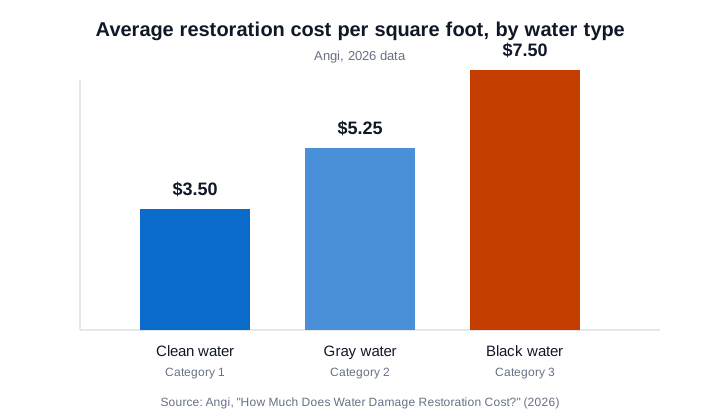
The headline rate is $3 to $7.50 per square foot, and the single biggest reason for the spread is the type of water involved. Restoration professionals classify water into three categories under the IICRC S500 standard — clean, gray, and black — and each step up in contamination adds protective equipment, containment, disposal, and cleaning time to the job. Angi's 2026 averages break the average cost per square foot down like this:
| Type of water (IICRC category) | Average cost per sq. ft. | Typical sources in a home |
|---|---|---|
| Clean water (Category 1) | $3.50 | Broken supply lines, burst pipes, overflowing sinks and tubs, rainwater that has not contacted contaminants |
| Gray water (Category 2) | $5.25 | Washing machine and dishwasher overflows, toilet overflows with urine only, sump pump failures with standing water |
| Black water (Category 3) | $7.50 | Sewage backups, river and storm flooding, seawater, water that has sat long enough to support microbial growth |
Those rates describe the repair of the damaged area. To see what they mean on real rooms, multiply them out — this is arithmetic on Angi's published averages, not a surveyed local price:
| Affected area | Clean water at $3.50/sq. ft. | Gray water at $5.25/sq. ft. | Black water at $7.50/sq. ft. |
|---|---|---|---|
| 100 sq. ft. (small bathroom) | $350 | $525 | $750 |
| 200 sq. ft. (bedroom or basement corner) | $700 | $1,050 | $1,500 |
| 400 sq. ft. (family room) | $1,400 | $2,100 | $3,000 |
| 600 sq. ft. (finished basement) | $2,100 | $3,150 | $4,500 |
Real invoices then add the work the per-square-foot figure does not capture on its own: the emergency water extraction cost, days of structural drying equipment, demolition of unsalvageable material, and the rebuild. That is why a burst-pipe job — the pipe repair plus the damage the water did — typically totals $1,000 to $4,000 according to Angi, and why the average insurance claim for water damage reaches $15,400. The per-square-foot rate is your unit price; the size of the loss and the category of water decide how many units you buy. When you compare a restoration estimate against this guide, check that it states the category and the affected square footage. A quote without those two numbers cannot be checked against anything. Whatever label an invoice puts on the work — a water removal price, a basement water damage cost, or water damage cleanup prices — the total is built from these same components.
Pro Tip: Ask every provider for the same three figures — water category, affected square footage, and the drying plan in days. With those, you can compare any two quotes against the per-square-foot ranges above. Without them, you are comparing totals with no shared basis.
How does the type of water change the price?
Black water costs more than double clean water per square foot — $7.50 against $3.50 in Angi's data — and the reason is scope, not markup. Clean water on a floor for an hour is an extraction and drying job. Black water is a decontamination job: crews work in protective equipment, porous materials the water touched — carpet, pad, insulation, drywall, upholstered furniture — are typically removed and disposed of rather than dried, and the surfaces that remain are cleaned and disinfected. More of the room leaves in bags, and more of it has to be rebuilt.
Category also moves over time, which is the expensive part of waiting. Water that starts as Category 1 does not stay clean: as it sits, it picks up contaminants from building materials and supports microbial growth, and the classification degrades. The U.S. Environmental Protection Agency's mold guidance makes the same point from the health side — it is important to dry water-damaged areas and items within 24 to 48 hours to prevent mold growth. Miss that window and a drying job can become a drying job plus mold removal, which Angi prices at an average of $2,369 as its own line item. In other words, the cost to dry out a house is partly a function of the calendar: the same leak costs materially more on day four than on day one.
This is why flood cleanup cost in Burlington County runs high even for shallow water. Water that enters from outside — from the Delaware River, Rancocas Creek, or a surcharged storm drain — is Category 3 by definition, no matter how clear it looks. A river-town homeowner in Palmyra or Riverside with two inches of floodwater across a basement is buying the $7.50-per-square-foot scope, plus disposal and rebuild, before any discussion of how deep the water was.
What does a burst pipe actually cost, start to finish?
A burst pipe is the most common way Burlington County homes meet this price list, so it is worth pricing end to end. Angi puts a burst-pipe repair plus the resulting water damage at $1,000 to $4,000 in total. That total has four parts, and seeing the parts explains where a quote can legitimately land inside the range:
- The plumbing repair itself — cutting out and replacing the failed section of pipe. This is the smallest part of the bill and, notably, the part homeowners insurance often treats separately from the water damage it caused.
- Emergency water extraction — removing standing water with truck-mounted or portable extractors. Speed matters here: extraction in the first hours limits how far water migrates into walls and subfloor.
- Structural drying — air movers and dehumidifiers placed from moisture readings, typically running three to five days for common materials (a typical range; it varies by job), and longer for dense ones like hardwood and plaster. Equipment runs continuously, and the crew returns to take readings against a dry standard.
- Demolition and rebuild — baseboards, drywall, flooring, and insulation that cannot be dried in place come out, and the room is put back. Finished rooms cost more to restore than unfinished ones because there is more to rebuild.
A small supply-line leak caught the same day, in an unfinished basement corner, sits near the $1,000 end: little demolition, a short dry, minimal rebuild. A burst pipe on an upper floor that runs while the house is empty — soaking ceilings, walls, and hardwood on the way down — climbs past $4,000 quickly and into the territory of that $15,400 average insurance claim. The water mitigation cost is set less by the pipe than by how much of the house the water visited and how long it stayed.
Pro Tip: Photograph and video every affected room before anything is moved or cut, and keep the damaged materials your provider removes until your insurer says otherwise. Documentation is what turns a restoration bill into a payable claim — more on that in the insurance section below.
Why do Burlington County jobs run higher after storms?
The rates above are averages in normal weeks. Burlington County's flood history shows what the abnormal weeks look like. On July 12, 2021, a flash flood on the Delaware River corridor in western Burlington County brought NWS-reviewed rainfall of about 3.5 to 7.6 inches (7.6 in Florence, 5.5 in Delanco, 5.0 in Beverly, 4.7 in Riverside, 3.5 in Palmyra). There were 12 water rescues countywide, in Florence, Edgewater Park, Palmyra and Riverside; Burlington City and Delanco had street flooding and Beverly had downed wires. When a whole county calls for emergency water extraction on the same night, three things happen to price and timing: crews and drying equipment are committed days out, the jobs themselves are disproportionately Category 3 floodwater rather than clean plumbing leaks, and finished basements — the norm in the Mount Laurel, Marlton, and Medford suburbs — mean the rebuild share of every bill is larger.
The county's other flood system, the Rancocas Creek basin, produces the same effect on a smaller scale in Pemberton, Browns Mills, Lumberton, and Mount Holly, and the July 2004 flood — more than six inches of rain basin-wide (USGS recorded 11.3 inches at New Lisbon and 13.2 at Tabernacle) and a federal disaster declaration for Burlington and Camden counties — remains the modern benchmark for how much water this county can take at once. None of this changes the per-square-foot math. It changes how many homes are doing that math simultaneously, and how long each one waits for a crew. The practical consequence for cost: after a county-wide event, getting into a provider's schedule early is worth real money, because a basement that waits a week for drying is a basement that may add mold removal and more demolition to the original scope.
Pro Tip: After a county-wide storm, call before you finish documenting. You can photograph the damage while you wait for a crew; you cannot get back the drying days you lose at the end of the queue.
It is also worth holding FEMA's illustration next to the local record: roughly $25,000 in damage from even one inch of water in a home. Shallow flooding is not minor flooding. Flooring, drywall, insulation, cabinets, electrical, and appliances all sit within the first inch's reach, which is why flood cleanup prices surprise people who picture damage scaling with depth.
Does insurance pay for water damage restoration, and what decides it?
For most homeowners, the restoration bill is really two bills: the one the provider charges and the one the insurer agrees was covered. The dividing line in a standard homeowners policy is whether the damage was sudden and accidental. A burst pipe, a failed water heater, a supply line that lets go — these are the textbook covered events. Damage that built up gradually — a slow leak under a sink, seepage through a foundation, rot from deferred maintenance — is generally excluded, and the dispute over which side of that line a loss falls on is why water claims are so often denied — one trade report cited a figure of about 10%, without naming a study.
The Insurance Information Institute's numbers show how common the covered side is: water damage and freezing accounted for 22.6% of homeowners claims in 2023 (between 19.8% and 28.7% in each year from 2019 to 2023), with about 1.5 water damage or freezing claims per 100 insured homes a year (roughly 1 in 67) over 2019-2023, and the average claim is $15,400. Two exclusions catch Burlington County homeowners most often. First, flooding from outside the home — river water, storm surge, surface water — is not part of a standard policy at all; it requires separate flood insurance through the National Flood Insurance Program or a private flood policy. For homes along the Delaware and the Rancocas, that is the single most expensive misunderstanding in this guide. Second, sump pump failure and sewage backup are usually covered only if you bought the specific endorsement for them — a point that matters in every basement in the county.
What decides a borderline claim is documentation. Adjusters pay on evidence: photos taken before cleanup, the provider's moisture readings and drying log, and a scope written in the category-and-class language of the IICRC S500 standard. A claim that arrives with those records is a routine file. A claim that arrives as a finished invoice and a story is a negotiation. This is also why an exact restoration estimate cannot exist before an inspection — the classification that sets both the price and the coverage decision comes from readings taken in the home, not from a phone description.
Key Takeaways
| Question | The short answer |
|---|---|
| What is the average rate? | $3 to $7.50 per square foot (Angi, 2026), set mainly by the type of water. |
| What does each water type cost? | Clean water $3.50, gray water $5.25, black water $7.50 per square foot (Angi, 2026). |
| What does a burst pipe cost in total? | $1,000 to $4,000 for the repair plus the resulting water damage (Angi). |
| How big do claims get? | The average water damage and freezing claim is $15,400, and water is 22.6% of all homeowners claims in 2023, and 19.8% to 28.7% in each year from 2019 to 2023 (Insurance Information Institute). |
| What keeps the bill down? | Drying within 24 to 48 hours (EPA) — before mold removal, averaging $2,369 (Angi), becomes a second job. |
An estimator's view: why two quotes for the same room can differ by 3×
The expert section of this guide is written from the estimating side of the restoration business — the person who scopes the job is the person whose numbers decide both your bill and your claim.
Homeowners call me, in effect, with the same question: two companies walked through the same wet basement, and one quoted a third of the other. In my experience that gap is almost never about one company being honest and the other not. It is about classification. The first decision on any water job is the category of the water and the class of the loss — how contaminated, and how much material is wet. Call a three-day-old leak clean water and a simple dry, and the quote is small. Classify it correctly — water that has sat, wicked into drywall and insulation, and degraded — and the scope now includes demolition, disposal, antimicrobial treatment, and a longer, monitored dry. Same room, same water, two different jobs on paper.
The second difference is documentation. A quote built on moisture-meter readings, a drying plan measured against a dry standard, and daily logs is a quote an insurance adjuster can pay. A quote that is one round number with no readings behind it is a quote you may end up defending alone. When you compare two restoration estimates, do not start with the totals. Start with the category, the class, the square footage, and the drying days — the quote that shows its work is the one priced on what is actually in your walls.
Standing water does not wait for business hours
Every hour water sits, the category can degrade, the drying takes longer, and the bill grows. Describe the problem once and get matched with an independent water damage provider who serves your Burlington County town — the provider confirms timing and price with you directly, and you compare before you commit.
A matching service by Signpost Local — not a contractor. Call (833) 246-4240 to describe the problem once; the call button above dials the same number.
Frequently asked questions
What is the average water damage restoration cost in Burlington County, NJ?
There is no surveyed Burlington County price list, so local quotes track national averages: Angi's 2026 data puts water damage repair at $3 to $7.50 per square foot depending on the type of water. A burst-pipe job with its resulting damage typically totals $1,000 to $4,000, while a flooded finished basement can reach five figures.
Does homeowners insurance cover water damage restoration?
A standard homeowners policy usually covers water damage that is sudden and accidental, such as a burst pipe or a failed supply line. It generally does not cover gradual leaks, seepage, or deferred maintenance, and flooding from outside the home requires a separate flood insurance policy.
What raises the price of water damage restoration the most?
The category of water is the biggest single factor: at Angi's 2026 averages, black water costs $7.50 per square foot to repair, more than double clean water at $3.50. Finished materials such as hardwood, cabinets, and built-ins also raise the bill because more of the room has to be removed and rebuilt.
Is mold removal included in a water damage restoration quote?
Usually not. Mold removal is normally a separate line item, and Angi puts the average mold removal job at $2,369. Drying a home within 24 to 48 hours, the window the EPA recommends, is the main way to keep mold work off the bill entirely.
Can a restoration company give an exact price before visiting?
No. An exact price requires an in-person inspection, because the cost depends on the water's category and on moisture readings inside walls and floors that cannot be seen from photos. A company can give a range by phone, but a firm quote follows classification and moisture mapping at the home.
Recommended Reads
- Does Homeowners Insurance Cover Water Damage? What NJ Homeowners Get Wrong — the sudden-and-accidental rule, the exclusions that surprise people, and how to document a claim so it survives the adjuster.
- Which Burlington County Towns Flood — and Why the Delaware River Is Only Half the Story — the county's two flood systems, the towns each one reaches, and how to check your own parcel.
- Water Damage Categories and Classes Explained (IICRC S500) — the two ratings on every estimate: what category and class mean, and how they set scope, safety, and price.
- Water in Your Basement? The First 24 Hours in a Burlington County Home — the emergency checklist: what to do in the first hour, what never to do with standing water, and how to document damage before cleanup.
- How Long Does Water Damage Restoration Take? A Day-by-Day Timeline — the four phases, why drying typically takes 3–5 days, and how "done" is measured by readings, not dates.
- Frozen and Burst Pipes in New Jersey Winters: Prevention, First Moves, Real Costs — the 20°F rule, the pressure mechanism, and why the damage bill dwarfs the repair bill.
- Water Damage in Burlington County, NJ — Local Pros, One Call — the matching page: describe the job once and get connected with a provider who serves your town.
- Which towns in Burlington County are covered? — the 29 towns and neighborhoods providers in the network serve.
This guide completes the site's ten-guide set. Every guide is linked from the home page and from each guide's Recommended Reads.
Sources
- Angi — How Much Does Water Damage Restoration Cost? (2026 data): per-square-foot rates overall and by water type, burst-pipe totals, and the average mold removal cost used in this guide.
- Insurance Business Magazine — water damage claim denials: the sudden-and-accidental standard, a trade-report figure of about 10% for denials (no study named), and Insurance Information Institute figures (22.6% of claims in 2023; $15,400 average claim, 2019–2023).
- U.S. EPA — A Brief Guide to Mold, Moisture and Your Home: dry water-damaged areas and items within 24–48 hours to prevent mold growth.
- FEMA / FloodSmart — Group Flood Insurance Policy outreach toolkit: FEMA's outreach materials illustrate that even one inch of water can cause roughly $25,000 in damage.
- Burlington County flood planning documents and NWS review of the July 12, 2021 flash flood (no link): rainfall of about 3.5 to 7.6 inches and 12 rescues countywide.
Ask an AI about water damage costs in Burlington County
Open your assistant with this page already loaded as context.