Burlington County, New Jersey · Insurance guide
Does Homeowners Insurance Cover Water Damage? What NJ Homeowners Get Wrong
A standard homeowners policy covers water damage that is sudden and accidental — and almost nothing else. A burst pipe is in; a slow leak, a rising river, and a decade of deferred maintenance are out. That single line decides most water damage insurance claim outcomes, and it is not where most homeowners think it is drawn.
WaterPros Burlington County is a matching service by Signpost Local — not a contractor and not an insurer. This guide explains how coverage works in general terms; your own policy's declarations and endorsements are the final word on your claim.
Water damage is not a rare edge case in American homeownership — it is one of the two most common claims there is. The Insurance Information Institute's data puts water damage and freezing at 22.6% of homeowners claims in 2023 (between 19.8% and 28.7% in each year from 2019 to 2023), second only to wind and hail, with about 1.5 claims per 100 insured homes a year (roughly 1 in 67) over 2019-2023 and an average claim severity of $15,400. Numbers that size mean the coverage question is not academic. It also means insurers have seen every version of a water claim, and they decide them by a rulebook that is more mechanical — and more knowable in advance — than most homeowners realize. This guide walks that rulebook: what is covered, what never is, why water claims are so often denied, and how to document a claim so it survives the adjuster. It pairs with this site's cost guide, which prices the work this coverage pays for.
Burlington County homeowners carry both sides of this risk at once. A large share of the housing stock is old enough that supply lines, water heaters, and washing machine hoses are at end-of-life — the sudden side of the line, where coverage exists but documentation decides. And a meaningful share of the county lives within reach of Delaware River, Rancocas Creek, and flash-flood water — the excluded side, where only a separate flood policy responds. Most local claim disappointments come from being prepared, and documented, for one side and uninsured on the other.
What water damage is covered?
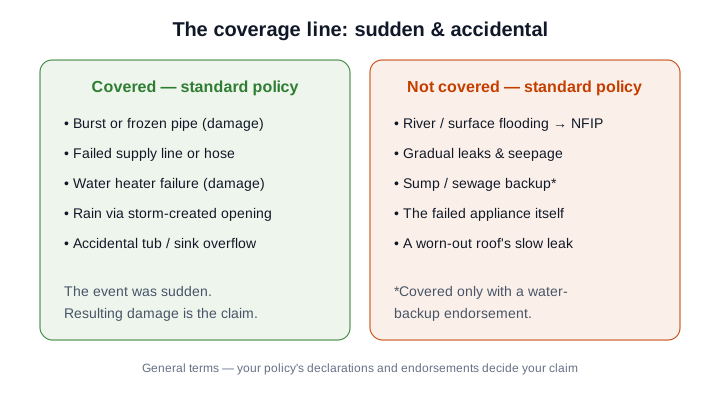
The covered side of the line is defined by the event, not the damage. If the water arrived through a sudden and accidental event, the resulting damage is generally covered, subject to your deductible and limits. In the industry's shorthand: sudden and accidental water damage is covered, and everything else must argue its way in.
- Burst and frozen pipes. Burst pipe insurance coverage is the textbook case: a pipe fails, water damages floors, walls, and contents, and the policy pays for the damage. Note the split that surprises people — the policy usually pays for the water damage, while the cost of repairing the pipe itself is often treated separately or excluded.
- Supply-line and appliance failures. A washing machine hose that lets go, a dishwasher that floods the kitchen, a water heater that fails suddenly — the resulting damage is typically covered. The appliance's own repair or replacement is not; that is maintenance.
- Rain through a storm-created opening. If wind tears shingles off or a limb punctures the roof, water entering through that new opening is generally covered, because a covered peril created the way in. A common insurer rule of thumb: water that comes from the top down is generally a homeowners policy matter; water that comes from the bottom up is a flood policy matter.
- Accidental overflow. A tub or sink that overflows and damages the floor below is a sudden event, treated like the plumbing failures above.
Two conditions ride along with all of it. First, coverage follows the loss being reported and mitigated promptly — policies expect the homeowner to prevent further damage, which is one reason the extraction-and-drying clock in our first-24-hours guide matters to the claim as well as the house. Second, "covered" means the resulting damage, priced as restoration work — the category-and-class scope an estimator documents, which the categories and classes explainer breaks down.
Two more mechanics decide what a covered claim actually pays. First, your deductible comes off every settlement — the number on your declarations page is the one to plan around. Second, many policies initially pay a depreciated value, called actual cash value, and release the remaining replacement-cost amount only when repairs are completed and documented. Neither rule is hidden; both are simply never explained until a check arrives smaller than the estimate it was measured against.
Pro Tip: When you file, describe the event, not just the damage. "The supply line failed Tuesday night" opens a claim. "The kitchen floor is ruined" opens an investigation into how long it has been wet — and that investigation is where claims go to die.
What is never covered (and surprises people most)?
The excluded side is where the expensive misunderstandings live. Four exclusions account for most of them:
- Flooding from outside the home. This is the flood insurance vs homeowners distinction, and it is absolute: rising water — a river over its banks, surface water pooling against the foundation, storm surge — is excluded from standard policies entirely. Flood coverage is a separate purchase, through the National Flood Insurance Program (NFIP) or a private flood insurer. NFIP policies are sold through insurance agents; check availability for your address with an agent.
- Gradual leaks and seepage. The gradual leak exclusion removes the other great category: the slow drip under the sink, the pinhole leak inside a wall, the shower pan that has wept for a year. Damage that built up over time is treated as maintenance the policy never agreed to fund, no matter how large the eventual discovery is.
- Sump pump failure and sewage backup — without an endorsement. These are typically covered only if you add a water-backup or sump pump endorsement, which is often relatively inexpensive and rarely mentioned at purchase. Without it, one of Burlington County's most common basement losses has no coverage at all.
- Mold beyond a sublimit, and mold from an uncovered cause. Mold is usually governed by a mold coverage sublimit — many policies cap mold coverage at a low sublimit; check your declarations — and it generally applies only when the mold follows a covered water event.
- Neglect after the loss. Damage that grows because mitigation never happened can be reduced or denied for the preventable portion — the burst pipe arguably covered on day one becomes a harder claim when three unmitigated weeks of mold growth are priced into it. The duty to prevent further damage is written into standard policies, and it starts at discovery.
Now the local part, because Burlington County is where the flood exclusion stops being abstract. The county's river towns — Burlington City, Beverly, Palmyra, Riverton, Riverside, Florence — sit on the Delaware and its tidal tributaries, and river flooding is precisely, specifically, the peril a standard policy excludes. The trap is that flash flooding reaches beyond the riverbank: the July 12, 2021 flash flood on the Delaware River corridor in western Burlington County brought NWS-reviewed rainfall of about 3.5 to 7.6 inches and put water into streets and homes in towns including Florence, Edgewater Park, Palmyra, Riverside, Burlington City, and Delanco — water that a standard policy still classifies as flood. FEMA's outreach materials illustrate the stakes: even one inch of water can cause roughly $25,000 in damage. A homeowner can do everything else right — maintain the house, document the loss, call within the hour — and still have no claim, because the one policy that covers their actual risk was never bought.
Why do water damage claims get denied?
Water claims are denied often — one trade report cited a figure of about 10%, without naming a study. The rate is not an accident of insurer temperament. Water is the one peril where the central coverage question — sudden or gradual? — is a judgment about the past that the physical evidence genuinely can support either way. A burst pipe and a six-month seep are both, at discovery, a wet wall and a ruined floor. The adjuster's job is to decide which story the evidence tells, and three patterns decide most denials:
- The evidence aged out. Water damage degrades on a schedule: the IICRC categories climb as water sits, materials swell and stain in ways that date the loss, and mold timelines give an adjuster a clock to argue from. A loss reported weeks late arrives pre-argued against itself — the home's own condition testifies that the damage was not sudden, or not recent.
- The documentation is a story, not a record. A denied water damage claim is usually a claim whose file contains an invoice and a description. Approvals run on artifacts: dated photos taken before cleanup, readings, receipts. Section four below is the difference, spelled out.
- The loss is real but the cause is excluded. A large share of denials are not disputes at all — they are the exclusions above applied to genuine losses: the flood with no flood policy, the backup with no endorsement, the slow leak discovered at demolition scale. These denials feel arbitrary to homeowners precisely because nobody explained the line before the loss, which is the entire reason this guide exists.
None of this means insurers deny claims they should pay as a business model — the same Insurance Information Institute data shows an average paid severity of $15,400 across an enormous volume of water claims, most of which are approved and paid as a matter of routine. It means the border is policed at exactly the sudden-versus-gradual line, and the homeowner's evidence decides which side a borderline file lands on.
Denial is also not always total. An adjuster can cover the sudden event and decline the aged portion of the same loss — the burst pipe's damage paid, the older seep behind the same wall excluded — or settle at depreciated value pending proof of completed repairs. Read a partial decision that way: it is an invitation to document the disputed portion, not an ending. The S500 scope and the drying log are the documents that move that line.
How do you document a claim so it survives the adjuster?
To file a water damage claim that reads as routine, build the file the adjuster would have built. The homeowners who fare best file water damage claim documentation early and completely — most of it in the first days, while the evidence is still wet. Five habits do most of the work:
- Photograph and video everything before cleanup — every affected room, the water line on walls, serial plates on failed appliances, contents in place. Time-stamped images from the day of discovery are the single strongest answer to "gradual." The first-24-hours guide turns this into an hour-by-hour checklist.
- Mitigate visibly, and keep the receipts. Stop the source, get extraction and drying started, and save every invoice — including the plumber's bill for the failed pipe, which establishes the sudden event even where the pipe repair itself is not covered.
- Get the scope written in the standard's language. A professional scope that states the IICRC category and class, the moisture readings against a dry standard, and a daily drying log is a document an adjuster can approve line by line. A one-line invoice total is a negotiation.
- Keep the damaged materials until the adjuster releases them. The failed hose, the cut drywall, the ruined flooring are physical evidence; disposing of them before inspection converts proof into assertion.
- Write the timeline the same day. When you discovered it, what failed, when you called, when drying started. Contemporaneous notes carry weight that reconstructions months later do not.
And one judgment call to make with clear eyes: weigh the claim against your deductible before filing. A loss that settles near the deductible buys little, and a claim history follows the policyholder. For the losses that clearly clear that bar — and a $15,400 average severity says many do — the five habits above are how the file earns its approval without a fight.
The first call itself deserves care. Report the loss promptly, get the claim number, and ask two questions: what documentation does the adjuster want to see, and when will inspection happen? Emergency mitigation should not wait for permission — policies require it — but large-scale tear-out before the adjuster has seen the loss can complicate approval of exactly the work that removed the evidence. The order of operations in the first-24-hours guide exists for this reason: stop the water, photograph, then dry, then demolish.
Pro Tip: Read your policy's endorsement page once, on a dry day. The two lines that decide Burlington County basement claims — water backup / sump pump endorsement, and your mold sublimit — are printed there, and both are far cheaper to fix before a loss than to argue about after one.
Key Takeaways
| Question | The short answer |
|---|---|
| What does a standard policy cover? | Damage from sudden and accidental events — burst pipes, supply-line failures, storm-created openings. The failed part itself is usually on you. |
| What does it never cover? | Flood from outside (separate NFIP/private policy), gradual leaks and seepage, and sump/sewage backup without a specific endorsement. |
| How common and how big are water claims? | 22.6% of homeowners claims in 2023 (19.8% to 28.7% in each year, 2019–2023), average severity $15,400 (Insurance Information Institute, 2019–2023). |
| Why do water damage claims get denied? | One trade report cited about 10% (no study named), because sudden-vs-gradual is decided on evidence, and late or undocumented losses argue against themselves. |
| What makes a claim survive? | Photos before cleanup, prompt mitigation with receipts, an S500-language scope with readings and a drying log, and the damaged materials kept for inspection. |
An adjuster's-eye view: the five documents that make a claim boring to approve
The expert section of this guide is written from the claims side of the desk — the standard a file is actually measured against.
Adjusters do not talk about deserving claims. They talk about documented ones. In my experience, the water claims that move without a fight share the same five documents, and a file that has all five is, in the best sense, boring:
- Dated photos and video from before cleanup — the loss as discovered, not as remediated.
- Proof of the sudden event — the plumber's invoice for the failed line, the appliance service record, the storm date. Something that anchors the loss to a moment.
- A professional scope in S500 terms — category, class, affected areas, and the moisture readings that support them.
- The drying log — daily readings trending to a dry standard, which closes the question of whether mitigation was real and timely.
- An itemized contents list — what was damaged, with serial numbers and receipts where they exist, matching the photos.
Notice what is not on the list: a persuasive phone call. Claims are not argued into approval at kitchen tables; they are documented into it, mostly in the first 24 hours, before the homeowner knows which documents will matter. That is the practical reason this site's guides keep returning to the same advice — photograph first, mitigate fast, keep everything. It is not fastidiousness. It is the claim. Every one of those documents is created, or lost, in the first day — before an adjuster ever visits the house.
Water damage now — start the file and the drying together
Describe the problem once and get matched with an independent water damage provider who serves your Burlington County town. A pro whose scope arrives with category, class, and readings is giving you restoration and claim evidence in the same visit.
A matching service by Signpost Local — not a contractor and not an insurer. No phone number is printed in this guide because the tracking number for this site is assigned at launch; the call button above is the route in.
Frequently asked questions
Is a leaking water heater covered by homeowners insurance?
Usually the damage is covered and the appliance is not. If a water heater fails suddenly, a standard policy typically pays for the water damage the failure caused — floors, walls, contents — while the cost of repairing or replacing the water heater itself is the homeowner's, as a maintenance expense.
Does insurance cover a roof leak after a storm?
Usually yes when the storm created the opening — wind tearing off shingles or a limb puncturing the roof lets water in through a sudden, covered event. A leak through a worn-out, deteriorated roof is treated as maintenance and is generally not covered. The distinction is the condition of the roof before the storm, which is why documentation matters.
Will filing a water damage claim raise my premium?
It can. Insurers may raise rates or reconsider a policy after claims, and the size of the claim matters — a payout barely above your deductible buys very little for the risk. Weigh the expected claim against your deductible before filing, especially for small losses you can document and pay out of pocket.
What if my water damage claim is denied as gradual damage?
Documentation is the appeal path. Photos from before cleanup, a written timeline showing when the loss was discovered, and a restoration professional's report written in IICRC S500 terms — category, class, and moisture readings — are the evidence that a loss was sudden rather than gradual. A denial letter states the reason; answer it with records, not descriptions.
Do I need flood insurance if my home is not in a flood zone?
Burlington County's own flood record says the risk is not zero: flash floods have put water in homes and streets across the county. Standard homeowners policies exclude flood entirely, and flood insurance is sold through the National Flood Insurance Program; check availability for your address with an agent.
Recommended Reads
- Which Burlington County Towns Flood — and Why the Delaware River Is Only Half the Story — the county's two flood systems, the towns each one reaches, and how to check your own parcel.
- Sump Pump Failed During a Storm? Why It Happens and How to Prevent a Flooded Basement — the five failure causes, the 5-gallon test, and the battery backup that keeps a basement dry when the power goes.
- How Much Does Water Damage Restoration Cost in Burlington County, NJ? — the numbers a claim has to cover: per-square-foot rates by water type and what drives a total.
- Water Damage Categories and Classes Explained (IICRC S500) — the classification language a well-built claim file is written in.
- Water in Your Basement? The First 24 Hours in a Burlington County Home — the hour-by-hour checklist that creates most of the claim's evidence.
- Sewage Backup in Your Home: Why It's a Biohazard Job, Not a Cleaning Job — Category 3 rules: what to do first, what gets thrown away, and the endorsement trap.
- Frozen and Burst Pipes in New Jersey Winters: Prevention, First Moves, Real Costs — the 20°F rule, the pressure mechanism, and why the damage bill dwarfs the repair bill.
- Water Damage in Burlington County, NJ — Local Pros, One Call — the matching page: describe the job once and get connected with a provider who serves your town.
- Which towns in Burlington County are covered? — the 29 towns and neighborhoods providers in the network serve.
This guide completes the site's ten-guide set. Every guide is linked from the home page and from each guide's Recommended Reads.
Sources
- Insurance Information Institute — Facts + Statistics: Homeowners and Renters Insurance: water damage and freezing at 22.6% of homeowners claims in 2023 (between 19.8% and 28.7% in each year from 2019 to 2023), about 1.5 claims per 100 insured homes a year (roughly 1 in 67) over 2019-2023, and average claim severity of $15,400 (2019–2023, ISO data).
- Insurance Business Magazine — water damage claim denials: the sudden-and-accidental standard, the gradual-damage exclusion, and a figure of about 10% for denials (no study named).
- FEMA / FloodSmart — Group Flood Insurance Policy outreach toolkit: flood damage sits outside standard homeowners coverage, and FEMA's outreach materials illustrate that even one inch of water can cause roughly $25,000 in damage.
- Burlington County flood planning documents and NWS review of the July 12, 2021 flash flood (no link): rainfall of about 3.5 to 7.6 inches and 12 rescues countywide.
- U.S. EPA — A Brief Guide to Mold, Moisture and Your Home: dry water-damaged areas and items within 24–48 hours to prevent mold growth — the timeline adjusters also argue from.
Ask an AI about water damage insurance coverage
Open your assistant with this page already loaded as context.