Burlington County, New Jersey · Sewage safety guide
Sewage Backup in Your Home: Why It's a Biohazard Job, Not a Cleaning Job
Sewage is Category 3 "black water" under the IICRC S500 standard — grossly contaminated by definition, carrying bacteria, viruses, and whatever else the sewer line held. That classification is why a sewage backup is not cleaned the way other water damage is cleaned. The job is a regulated cleanup: protective equipment, removal of contaminated porous materials, disinfection, and controlled disposal — not mopping with stronger chemicals. This guide explains what makes sewage different, what to do (and not touch) in the first hour, what professional black water cleanup actually involves, and the insurance endorsement most homeowners discover only after the bill.
WaterPros Burlington County is a matching service by Signpost Local — not a contractor and not a biohazard cleanup company. This guide summarizes the IICRC standard, CDC guidance, and restoration practice; anyone who has been exposed and feels ill should seek medical attention rather than finish reading.
The causes are mundane, which is part of the risk — nobody expects them. The sewer line backup causes a plumber lists are tree roots growing into the joints of an older lateral line, clogs built from grease and things that should never have been flushed, a failing or collapsed pipe, and the municipal version, sewer surcharge flooding: during the flash-flood events in this site's flood-risk guide, storm water overwhelms the sanitary system and the surcharge pushes back through the lowest openings in the house — a basement toilet backup or a floor drain becomes the system's pressure relief. Burlington County's older housing stock carries the in-home version of the risk: Burlington City, Riverside, Palmyra, and Mount Holly are full of homes whose original cast-iron and clay laterals have had decades in which roots can intrude and joints can offset. Either way, the water that arrives is the same, and it is why sewage cleanup cost sits at the top of the rate table — about $7.50 per square foot in Angi's 2026 data, the black-water rate, against $3.50 for clean water.
What makes sewage backup different from other water damage?
Three things, and together they change the whole job. First, the classification starts at the maximum. Clean water degrades over time — this site's categories and classes guide explains how a Category 1 loss can become Category 2 or 3 as it sits. Sewage arrives as category 3 water damage on minute one, with no cleaner phase to act in. Second, the contamination is biological. Sewage carries fecal bacteria and viruses and the chemical contents of a sewer line; sewage-contaminated floodwater is a health hazard, not a housekeeping problem. Third, the remedy is removal. In clean-water work, porous materials are dried and saved. Under S500/S520 practice for Category 3, porous materials the sewage contacted are typically removed and discarded, because contamination soaks into their structure where no cleaning reliably reaches. A sewage backup in basement carpet is not a carpet-cleaning problem; the carpet is waste.
| Cause family | How it happens | The usual first sign |
|---|---|---|
| In-home: roots and clogs | Tree roots enter lateral joints; grease and non-flushables narrow the line until it blocks and reverses. | Slow drains throughout the house, gurgling, then the lowest fixture backs up first. |
| In-home: failing lateral | Cast-iron or clay laterals crack, offset, or collapse after decades underground. | Recurring backups at the same fixture, often after heavy water use. |
| Municipal: storm surcharge | Flash-flood inflow overwhelms the sanitary system; pressure relieves through basement drains and toilets. | Backup during or just after a major storm, with neighbors on the street reporting the same. |
That third point is the one homeowners resist, and it is worth being plain about why the industry is inflexible: a biohazard cleanup home job is judged by whether contamination remains, not by whether the room looks and smells clean. Bleached carpet can test dirty. The standard protects the next decade of the room's life, not the afternoon's appearance.
What should you do (and not touch) after a backup?
The first hour has a short list, and most of it is restraint:
- Stop the source if you can do it safely. Stop using water and plumbing in the house — every flush and drain feeds the backup. If water is still rising from a municipal surcharge, there is nothing to shut off on your side; get out of its way.
- Keep people and pets out. Our guidance: children and pets stay out of the affected area until cleanup is complete. No exceptions for retrieving things that can wait.
- Do not run the HVAC if ducts, the air handler, or returns may have been exposed — you would distribute contamination through the house. (The mold guide makes the same point for wet ductwork.)
- Watch the electrical risk. Standing water and basement electrical — outlets, appliances, the panel — are a shock hazard. If water is near electrical equipment, stay out and let the responders sort it.
- Document from the doorway. Photos and video of the extent, the source point, and the contents affected — taken without wading in — are your insurance record. Then wash any skin that contacted the water, with soap, thoroughly.
- Call for the cleanup and call your insurer. In that order of urgency but the same hour: the sewage damage insurance endorsement question in the last section is answered by your policy, and the claim starts with this call.
What not to do: do not start mopping, do not carry soaked items through clean rooms (you would be seeding a trail), do not move contaminated soft goods into the garage "to deal with later" — they are discarded, and handling them twice doubles the exposure.
Pro Tip: Photograph the drain or fixture the sewage came from before anything is cleaned. Which opening relieved the pressure — floor drain, toilet, tub — is diagnostic evidence for whether the cause is your lateral or the municipal line, and it disappears the moment cleanup starts.
What does professional sewage cleanup actually involve?
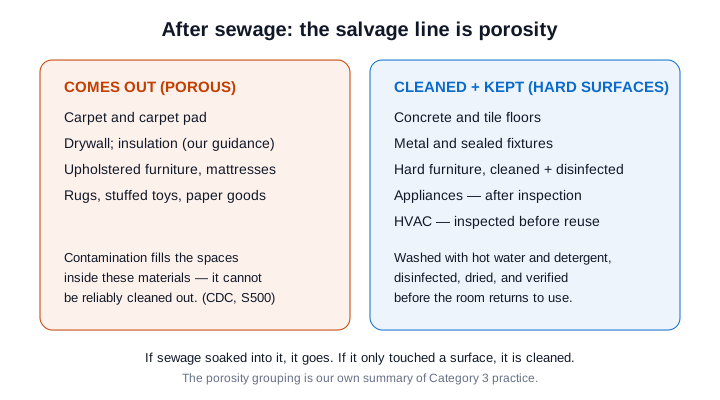
The professional sequence, in order: containment and protective equipment — the work area is isolated so contamination is not tracked or blown into clean space, and the crew works in gloves, boots, eye protection, and respirators. Extraction of the contaminated water and solids. Removal — the salvage line in the diagram above: carpet and pad, affected drywall and insulation, upholstered furniture, mattresses, and paper goods come out and are disposed of as contaminated waste; CDC floodwater guidance to discard wall coverings, cloth, rugs, and drywall points the same way (insulation is our guidance, not a CDC item). Cleaning and disinfection of everything that remains: hard surfaces washed with detergent and water, then disinfected — this is the step bleach actually belongs to, on surfaces that can be cleaned, as one step in the middle of the job rather than the whole job. Drying to the dry standard, verified with moisture readings like any other water job. And an HVAC inspection before the system runs again, if there is any chance of exposure.
Two cost realities follow from the sequence. The removal-and-replace scope is why the per-square-foot rate is the highest in water work — the $7.50 black-water figure from this site's cost guide — and the contents losses are often larger than the building losses: a furnished basement's soft goods are mostly a total loss in a Category 3 event. Neither is an argument for delay. Contact time is the variable that moves materials across the salvage line, so the fastest call produces the smallest discard pile.
Does insurance cover sewage backup?
Only if you bought the specific coverage — this is the sewage damage insurance endorsement trap, and it catches people the same way the sump endorsement does. As the insurance guide on this site lays out, a standard homeowners policy typically excludes water that backs up through sewers or drains. Coverage for it is sold as a separate water backup / sewer backup endorsement, with its own limit — and that limit is frequently far below the cost of a finished-basement Category 3 job. Homeowners who have "water damage coverage" in the general sense routinely discover they have no backup coverage in the specific sense.
The practical sequence: check the declarations page for the endorsement and its limit (a quiet-day task, like the sump check); if the backup has already happened, file promptly, hand over the doorway documentation, and keep the cleanup records — the pro's scope, disposal, and drying log are the claim's substance. One more distinction worth knowing: where the cause was the municipal line, some homeowners assume the town pays. Municipal liability is narrow (the FAQ below gives the honest version) — your endorsement is the payer you can actually plan on.
A portfolio note: sewage and biohazard work is a specialty of its own. Signpost Local's network includes a dedicated biohazard cleanup resource for the deep end of this work; your matched provider will tell you plainly if your job belongs there instead.
Key Takeaways
| Question | The short answer |
|---|---|
| Why is sewage different? | It is Category 3 from minute one — grossly contaminated — and the remedy for porous materials is removal, not drying or surface cleaning. |
| What do I do first? | Stop using the plumbing, keep children and pets out, don't run the HVAC, document from the doorway, wash any skin contact, and call. |
| What do pros actually do? | Contain, extract, remove contaminated porous materials, clean and disinfect hard surfaces, dry to standard, inspect the HVAC — in that order, in PPE. |
| What does it cost? | The highest rate in water work: about $7.50/sq ft (Angi 2026), plus contents — furnished basements lose most soft goods. |
| Does insurance cover it? | Only with a water/sewer backup endorsement, which has its own limit. Standard policies typically exclude sewer backup. |
A restorer's view: what gets thrown away, and why nobody is being dramatic
The expert section of this guide is written from the restoration side of the business — the crews who run Category 3 jobs.
The hardest conversation on a sewage job is the discard pile, because it looks arbitrary from the doorway: the rug goes but the tile stays, the sofa goes but the washing machine might stay. It is not arbitrary; it is one rule applied calmly. Sewage that soaked into a material cannot be verified out of it — carpet pad, drywall, upholstery foam, and mattress batting hold contamination in a structure no surface treatment reaches, so they leave. Sewage that touched a surface can be washed, disinfected, and verified — concrete, tile, metal, sealed wood — so those stay, after cleaning you could eat off the process of, if never the room's history. Appliances and the HVAC sit in between and get inspected, because their insides decide. When a crew member tells you a beloved item has to go, they are not upselling disposal; they are reading the line between what soaked in and what only touched a surface — our own summary of the practice. Ask them to walk the line with you, item by item. On a good crew, that walk is the most educational ten minutes of the whole miserable day.
Sewage in the house right now?
Describe the problem once and get matched with an independent provider who serves your Burlington County town and handles Category 3 work. Keep people and pets out of the area until they arrive — that single step does more than any cleanup you could start alone.
A matching service by Signpost Local — not a contractor. Call (833) 246-4240 to describe the problem once; the call button above dials the same number.
Frequently asked questions
Can I clean up a sewage backup myself with bleach?
For a small clean-water spill, home cleanup is reasonable. For sewage, no — and the reason is the material, not the chemical. Bleach on a hard floor is the last step of a professional job, not the job: the scope is extraction of contaminated water, removal of every porous material the sewage touched, cleaning and disinfecting what remains, and verified drying, done in protective equipment with the waste handled as contaminated. CDC floodwater guidance calls for wearing boots and gloves and discarding wall coverings, cloth, rugs, and drywall the water touched — a standard a mop and a bottle do not meet.
How soon does sewage cleanup need to start?
Immediately — this is the least postponable job in water damage. The category does not degrade the way clean water does; it starts at the maximum. Pathogen presence, odor, and material absorption all worsen by the hour, and every hour of contact moves more porous material from the 'clean it' column to the 'remove it' column. Stop using the affected plumbing, keep people and pets out, and make the call the same hour you find it.
Is the sewage smell in the house harmful?
A sewage smell in house air is a signal, not a measurement: treat it as a reason to stay out. The odor means sewage gases and contamination are present in living space; the exposure concern is less the smell itself than what it announces — bacteria and viruses on surfaces, in materials, and potentially in the air handling system. Until the area has been assessed and cleaned, keep children, pets, and anyone with a weakened immune system out of it, and do not run the HVAC if the system may have been exposed.
Will the city pay for my sewage backup damage?
Usually not, and it is worth knowing why before you count on it. Municipal liability for sewer backups is narrow: a city is generally responsible only where it was negligent — typically requiring that it knew of a defect in its line and failed to act — and many claims are denied on exactly that ground. Document everything anyway (photos, timestamps, the cleanup record), report the backup to the municipality promptly, and check — some towns have limited relief programs. But plan on your own insurance endorsement being the realistic payer.
How long until the room is usable again?
Typically days, gated by verification rather than by the calendar. The sequence — extraction, removal, cleaning and disinfection, then structural drying to the dry standard — often takes several days for a residential backup, and longer if the rebuild is significant. The room is usable when the work is verified complete: materials dry to standard, disinfected surfaces confirmed, and the HVAC cleared if it was exposed. A room that merely smells better is not the same as a room that is done.
Recommended Reads
- Water Damage Categories and Classes Explained (IICRC S500) — the classification system that makes sewage Category 3, and what the rating commands.
- Does Homeowners Insurance Cover Water Damage? What NJ Homeowners Get Wrong — the endorsement system, exclusions, and how to document a claim.
- Water in Your Basement? The First 24 Hours in a Burlington County Home — the general emergency checklist; the sewage version in this guide overrides it where they differ.
- Water Damage in Burlington County, NJ — Local Pros, One Call — the matching page: describe the job once and get connected with a provider who serves your town.
- Which towns in Burlington County are covered? — the 29 towns and neighborhoods providers in the network serve.
This guide completes the site's ten-guide set. Every guide is linked from the home page and from each guide's Recommended Reads.
Sources
- CDC — Floods: safety and cleanup guidance: general floodwater guidance, not sewage-specific — wear rubber boots and gloves; discard wall coverings, cloth, rugs, and drywall that floodwater touched; wash laundry in hot water. Keeping pets out, insulation removal, and disinfecting surfaces are our own guidance.
- IICRC — ANSI/IICRC S500 Standard for Professional Water Damage Restoration: Category 3 ("black water") is grossly contaminated; porous materials it contacts are typically removed rather than dried, with remediation practice under the companion IICRC S520 standard.
- Burlington County Hazard Mitigation Plan (2019), Section 5.4.4: the county's flash-flood event record behind the storm-surcharge discussion.
- Insurance Information Institute — Facts + Statistics: Homeowners and renters insurance: claims context for the coverage discussion; Angi's 2026 black-water rate (about $7.50/sq ft) is cited in this site's cost guide.
Ask an AI about sewage backup cleanup
Open your assistant with this page already loaded as context.